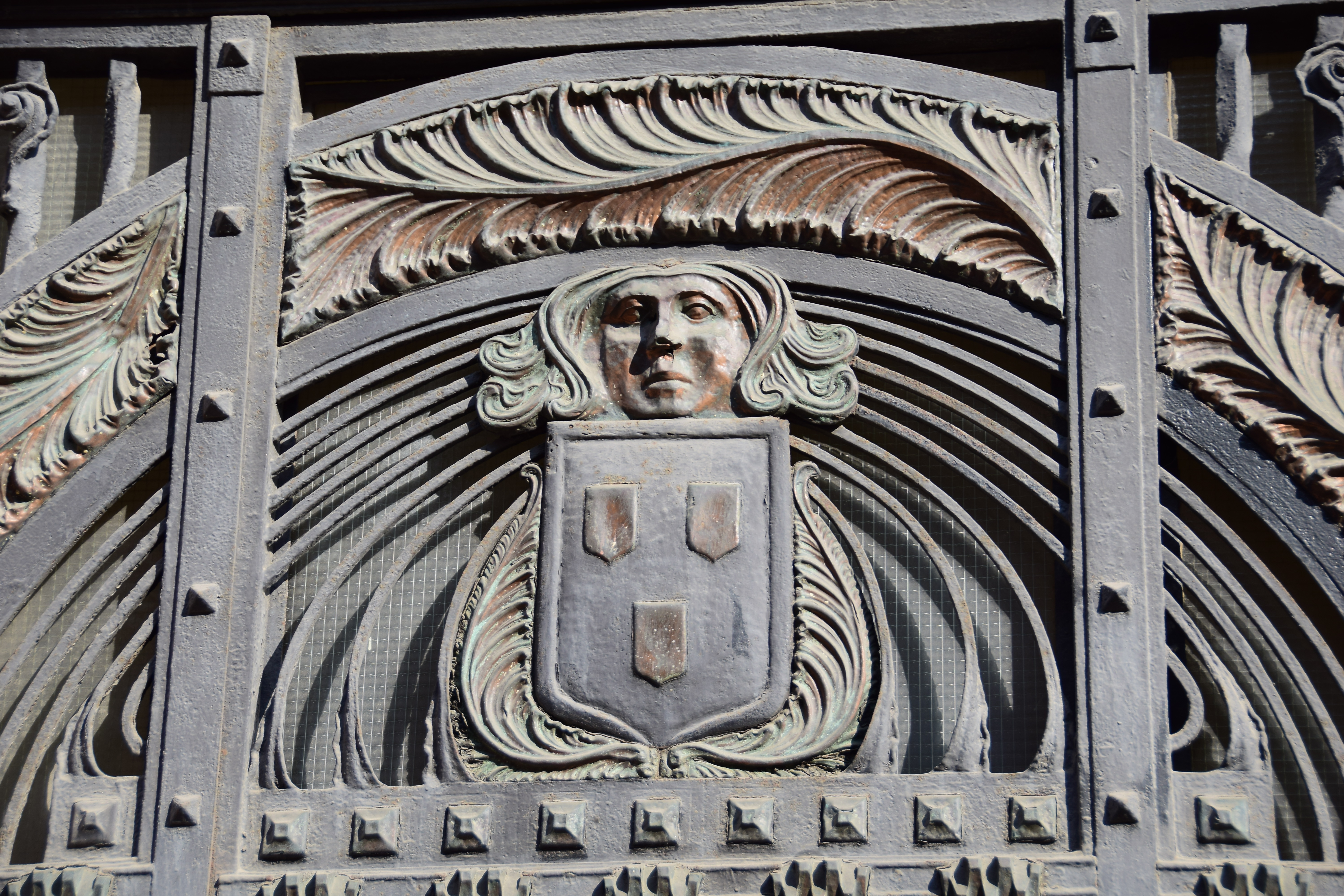
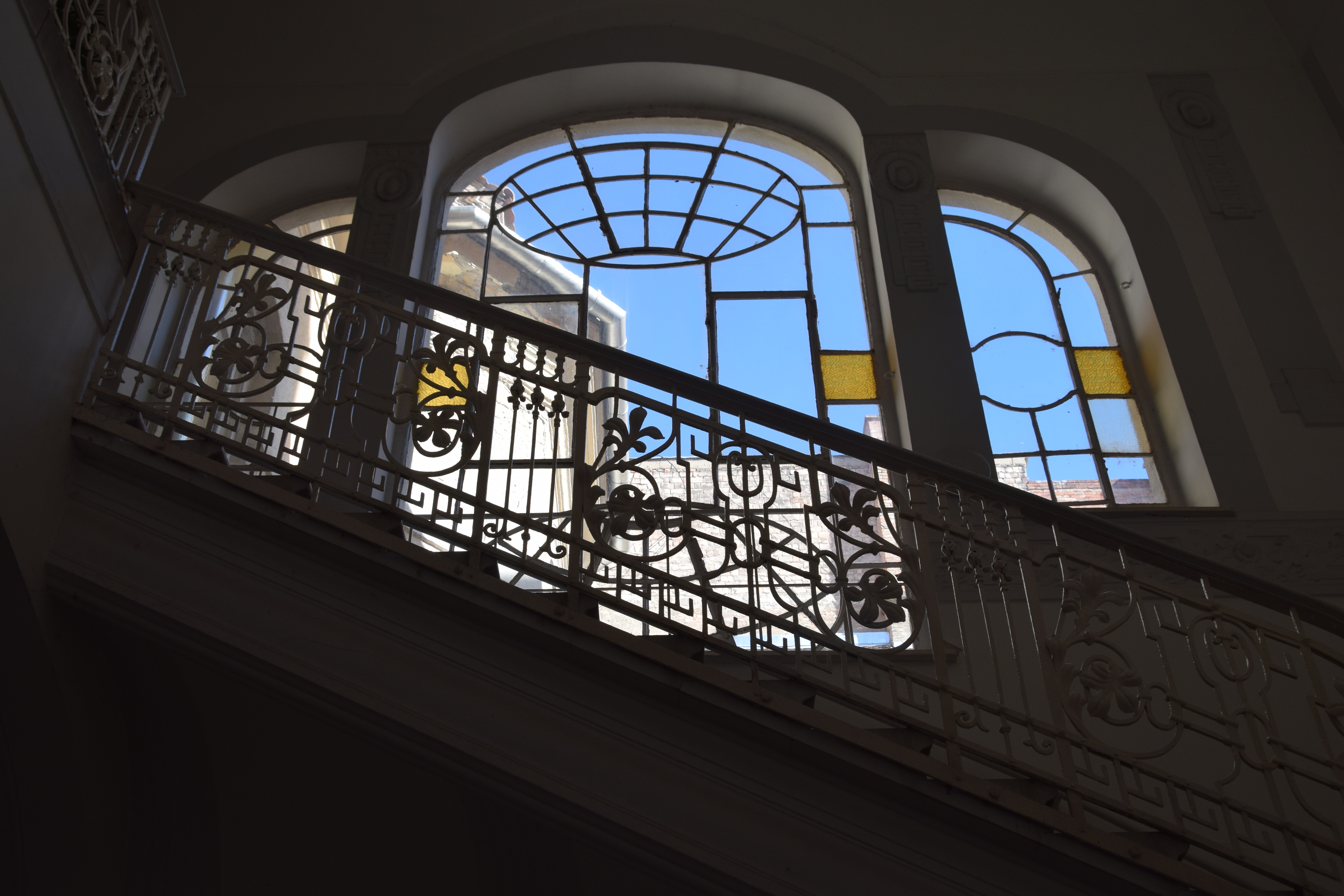
This is a photograph on a postcard bought in Budapest. It reminded Tony of me. I am always peaking into windows or doors, trying to see what is inside the houses I photograph. This year, I have had tremendous luck actually getting inside. Even buildings I never thought I would see. The secret is to hope someone is about to walk into the building, run up to meet them at door, smile pleasantly, gesture to the camera, and say "can I take a picture," pointing inside. Virtually everyone says yes. Sometimes, though, doors are even left open--for movers or cleaners. And I can just walk in and look around. I have too many to do a full post on every house I saw the insides of this year, so I am just going to offer some highlights. Seeing the interiors provides a different, richer, understanding of how these buildings worked. Again and again, they demonstrate the Hungarian love of ornament. ''
The next set of blog posts focus on interiors. Some are "ordinary" but interesting. Others show off the the beauty of highly trained artists and craftsmen. Most have a sustained aesthetic effect. Here, for example, Here, for example, is the interior of a fairly large eclectic building on Rakoczi ut built 1897-1898. Typical elements include the stucco decorations on the wall, the tiles on the stair well, and the wrought iron stair rail.
Not all the interiors of Budapest buildings are as sumptuous as those of Fodor (though as you will see in a subsequent post, some are even more so).
Thirteen years later, the building shown below at Falk Miksa 30 was built by Emil Agoston in 1903. It shows a much more secessionist aesthetic in its interior features: tiled floors designed to look like rugs, wrought iron railings and often elevator cage, glass or other ornaments.
The following interior is from a side entrance to a large corner building at the intersection of Dozsa Gyorgy ut and Atjos Durer utca designed by Dezso Denes. The gate ornament is identical to one used by Fodor on two entrances to a large udvar on Ulloi and Baross utca. Fodor's gate ornament was by Gero and Gyory, very famous iron work masters. so presumably this one is as well. (I couldn't find the signature which they generally used because of the way the door opened.) The eagle decoration of the interior reflects the eagle decoration on the door (which can't be seen with the door half open). Notice also here, and in other spaces, the tiles are designed to look like carpets.

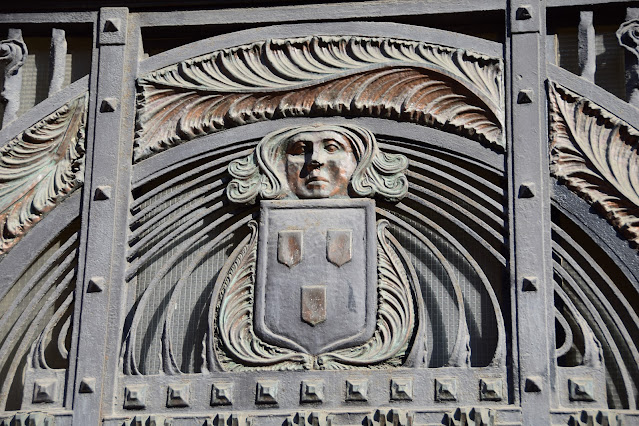


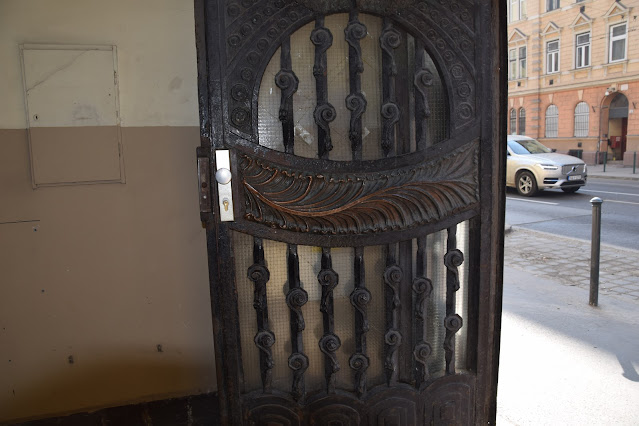
The next set of images come from a building that sits at the intersection of Dob utca and Rumbach Sebestyen utca in the Jewish Quarter, and was during the war a "Yellow Star House," a building designated for Jews before the closing of the Ghetto. It was built by Ernest and Miklos Roman, 1913-15. The building is notable for its external tiles, and the design and color scheme are continued inside.
Also in the Jewish district at the corner of Kazinczky utca 20 and Wesselenyi utca 16 is a building by Gyula Biro built in 1910, and described as (loosely translated by google) a premodern of late Art Nouveau." Maybe a little preview of Art Deco?


But just to show that the date doesn't necessarily dictate the style, here are pictures of rather ornate Eclectic-Neo-Baroque villa built in 1914 by Erno and Artur Schannen.. Though the exterior is very ornate, e.g.,
the interior (at least from the side entrance) is beautifully (and expensively) simple.
On our last day in Budapest we walked down Varosligeti fasor, which is my favorite street in Budapest--a virtual museum of Art Nouveau architecture--and up Benczur, another fabulous street. On Benczur, I saw the interior of a house by Sandor Fellner in 1906. How do I know this? He very helpfully signed his name.
TERVETZE
FELLNER SANDOR
EPITESZ
MCMVI
BUILDER
FELLNER SANDOR
ARCHITECT
MCMVI
#BudapestArtNouveauInteriors