We were in Oradea, Romania in 2009, when we first saw this little modernist gem. It is the Darvas-LaRoche House and it was designed by two brothers, Joseph and Laszlo Vago in 1910-1911. Though Joseph and Laszlo Vago were born in Oradea, then part of Hungary, the Darvas LaRoche House is more Vienese than Hungarian. Except for the statue (which itself is definitely not Hungarian) the building has no figural aspects.
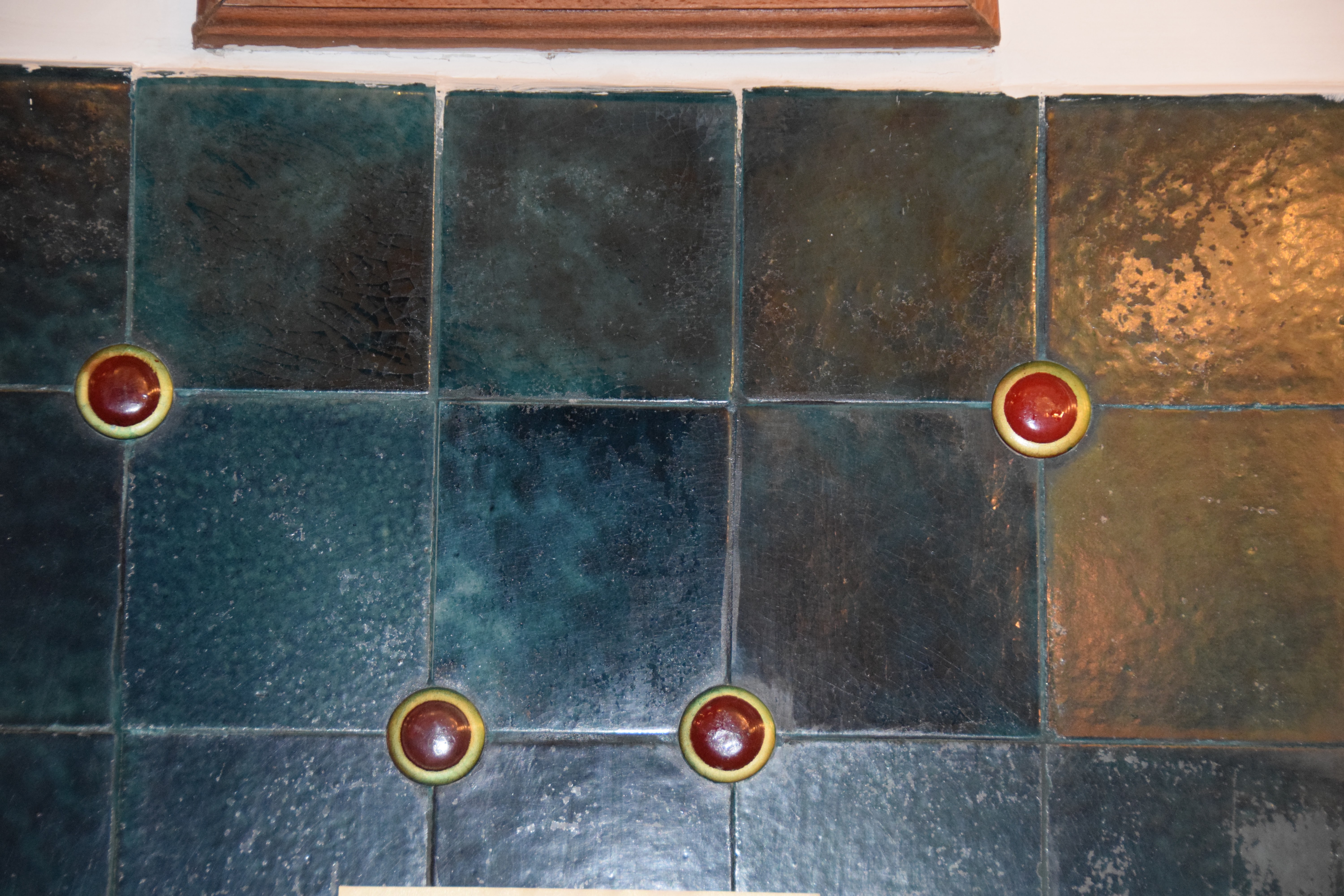
The studs are meant to suggest rivets rather than embroidery knots.
The Vago brothers also designed another house in Oradea, this one decorated with incised naturalistic figures and playful tiles.
When we went for one of our first walks in Budapest, we stumbled on one of the most famous buildings of the Vago Brothers, the toy shop,Arkad-Bazaar (1908-1909), on Dohany Utca on the edge of the Jewish District.
The Vago Brothers also designed the building (1907) for the Hungarian book printers and typefounders organization on what is now Gutenberg Ter. The building was meant to include apartments, shops and offices.
It has many of their characteristic features.
While the outside of the building is somewhat dilapidated, the inside is said to have been restored. (Though getting inside these buildings is a major challenge.)
Later on a walk on Népszínház Utca, armed with a page pointing out many notable buildings, we came across one un-noted building that we immediately recognized as by the Vagos.
It is a wonderful feeling and a special kind of "knowing" to become familiar enough with an architect's style to be able to recognize their buildings. (Admittedly the Vagos' style is unique.)
The Vago brothers went on to buildm separately and together, other buildings in Budapest, including working on the famous Gresham Palace, now a fabulous Four Seasons hotel. Many of their buildings, unlike the marvelously restored Gresham Palace, are quite dilapidated. They collaborated until 1911. Laszlo Vago (1875-1933) worked with other architects on city planning projects. Jozsef Vago went on to work with Odon Lechner. He also designed the beautiful Schiffer villa in Budapest, A Marxist socialist, he emigrated to Switzerland and Italy. He tried later to return to Budapest, but by then anti-semitic laws made working as an architect impossible. He then emigrated to France and worked in urban planning.