Showing posts with label Hungary. Show all posts

Friday, March 13, 2020

Kiskunfelegyhaza: Extraordinary Town Hall with Zsolnay Ornaments


Kiskunfelegyhaza (if you can pronounce it you're better than me!) is a small city about an hour and a half train ride from Budapest.  It has an extraordinary Town Hall that we have long wanted to see.  So we hopped on a train and spent the day there.


Town Halls were important structures in Hungary around the turn-of-the-century.  They attested to civic identity in a country that was growing by leaps and bounds.  Kiskunfelegyhaza invited designs in 1903 but controversy greatly divided the town.  Should they keep the older classical style or build their town hall in the new Hungarian style of Odon Lechner and his followers? (There is a lot of ideology and history, as well as aesthetics, embedded into this question.)  The latter side won, and the commission was given to Jozsef Vas, who began construction in 1909.  After Vas's death, Nandor Morbitzer completed the building in 1911, adding the tower to keep the building even more in line with the Lechner school.


The building is decorated with Transylvanian folk motifs, including flowers, hearts and a multi-colored roof.


The inside was attractive as well, but paint obviously doesn't hold  up in the way the technology of the external Zsolnay tiles does. 


Later we got to see the façade in the slanting late afternoon sun, making the colors glow differently and the ornaments almost three-dimensional in appearance.


There were some other interesting buildings in this little city, but the Town Hall is clearly the star of the show.

Here for example is a building decorated with small tiles.  The little round decorations are drawn from Transylvanian embroidery knots.  


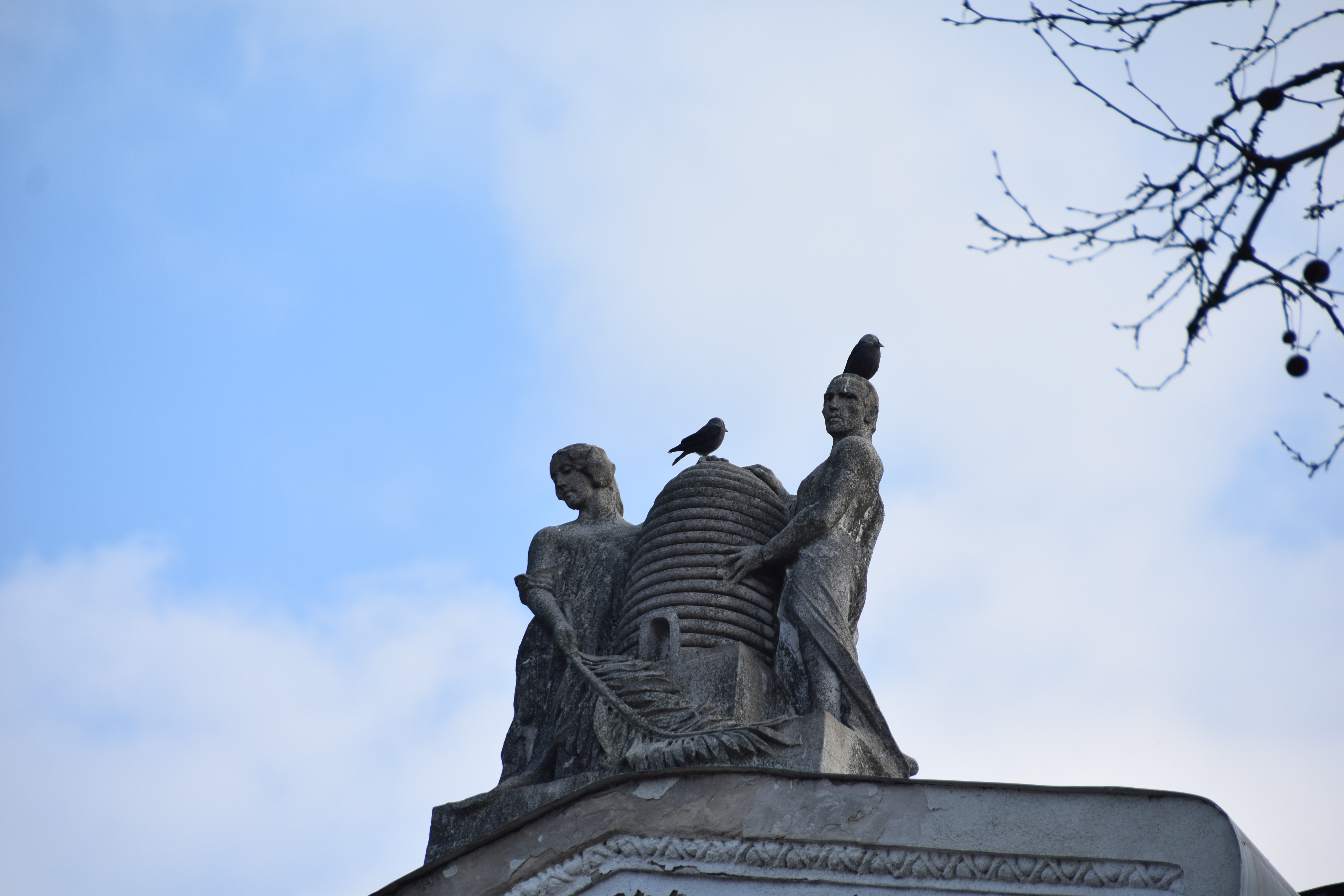
 A beehive on the top of a building, signifying this was once a bank (bees storing honey is an image of "saving.")


More little dots.


 And a perfect Art Nouveau railing.


#Kiskunfelegyhaza
#HungarianTownHall
#Zsolnay


Thursday, December 22, 2016

Back to Budapest

Buda Castle from Pest

Tony and I spend a little under half the year in Michigan and a little over half the year in Louisville, but our "medical home" is Louisville.  So when we come back from Michigan we spend a month or so making our semi-annual visits to our various doctors.  Happily this year, everything turned out fine.  So now I can trust the future and say that we are going back to Budapest in February.

We will spend a month at the beautiful Apartment Andrei in Budapest.  Then we will take a train to Prague and spend a week there before flying home.  A lot of people ask me why we keep going back to Budapest, and that's a question that is complicated and difficult to answer. Partly we like to "return."  We like going someplace we have already staked out as tourists and then coming back with a sense of how that city "works."  (We've done this, though not on such a large scale as Budapest with Venice and Paris.)  We also like to feel as though we "live" in a city, and it's only really possible to spend the month that takes in an affordable city which Budapest (uinlike Paris or Venice) is.  We like feeling we know our neighborhood, our favoite restaurants, our music spots.  We like living like "rich" people, which Budapest--being so cheap--allows.  

Budapest is also seems an almost infinite series of interesting streets.  We keep turning the corner and finding something new.  And with this comes a feeling of discovery, as though we were exploring some fantastic place.  The pleasures of  navigating new and unfoldingly more complicated spaces is often identified as one of the reasons people play video and other games.  So it's a kind of ludic, as well as aesthetic and intellectual, pleasure. 

#Budapest
#ReturntoBudapest

Monday, December 21, 2015

Was Miklos Ligeti Jewish?


Last spring, I wrote a post on Miklos Ligeti's sculpture.  I first became acquainted with Ligeti's sculpture in the Kerepesi Cemetery in Budapest.  The Kerepesi Cemetery was the main Christian cemetery in Budapest at the end of the nineteenth and beginning of the twentieth centuries.  Behind the Kerepesi Cemetery is the Jewish Salgotarjani Cemetery, much less kept up, much more difficult to enter and view,  The tombs by Ligeti in the Kerepesi Cemetery feature the nude human body and physical manifestations of angels--both quite distinct from the Jewish tradition of funeral art:


Ligeti also sculpted important politicians, artists, and even the royal Austro-Hungarian family.  But his most famous statue is Anonymous, which for many captures the essential Hungarian identity.


It was thus a complete surprise for me to read in Jewish Budapest: Monuments, Rites, History (by Kinga Frojimovics, Geza Komoroczy, Victoria Pustai and Andrea Strbik) the following passage:

"The Regent [Miklos Horty] issued privileges at special requests for some people who now fell under the (Anti-) Jewish Laws but who had outsanding scholarly, artistic, economic achievements to their credit or who filled prominent public roles.  . . .  Among them were several prominent. . . writers and artists, [including] . . Miklos LIgeti, the sculptor of the statue (1903) of the first Hungarian chronicler, Anonymous, located in Varosligeti (City Park)" (p. 402).

That Ligeti could be Jewish seemed almost impossible.

So I did some research.  Miklos Ligeti, sculptor is listed in the Maygar Zsido Lexicon (Hungarian Jewish Encylopedia), published in 1929 in Hungarian.  Ligeti is also listed on ArtCult: Around Jewish Art,

The answer to how Ligeti could be Jewish but seem (in his art) so un-Jewish is of course the widespread cultural assimilation of Hungarian Jews in the last part of the 19C and first part of the 20C.  The historian and political writer Ferenc Festo, who includes Ligeti in his discussion, explains this more thoroughly.

Ligeti died in 1944 (the death year for so many Budapest Jews). As Jewish Budapest goes on to explain, the special "accommodation" for outstanding Jewish citizens declined after the Arrow Sword terrors. ArtCult says that Ligeti "disappeared" in Budapest in 1944.  His wikipedia page and other websites place his death on December 10, 1944, the day the Budapest Ghetto was sealed.  Interestingly, in a book published by the museum his family runs, Ligeti Miklos by Prohaszka Laszlo, Ligeti's death is also placed on December 10, 1944--though there is no mention (as far as I can tell using Google translate) of his residing in the Ghetto or dying because of the Holocaust.

Ligeti's own funeral monument is located in Kerepesi Cemetery, though his body (which was lost) is not.  The monument sculpted by his friend Jeno Bory poignantly depicts the missing presence.

  .
In the abstract to her doctoral thesis, Treat ment of Miklós Ligeti ,sculptor’s ouvre, Judit Mazányi writes that "Surveying his oeuvre, it became indisputable that we were not kept waiting for the rediscovery of the life-work of a forgotten genius sunken into oblivion":

"Sadly, no drawn sketches have survived from the artist, nor sculpture studies of a notable number, through which the evolution of his ideas could have been traced. Many hundreds of his drawings fell victim to the mistaken judgment of his family members, who, in the cultural-political situation following the war might have thought that there would not be any chance to present his oeuvre as integrated into Hungarian art. I do not know which of his works were placed in a private safe during World War II as planned by the artist, but it is common knowledge that the valuables preserved in these were hardly spared in the course of wartime plunder, and these works have most probably been destroyed."

The hooded face, the body-less monument, the Jewish identification, the non-Jewish artist: it is tempting to draw these together.  But the truth of Ligeti's life is surely more complex than these teasing traces suggest.  It is also as incompletely known as those of so many Hungarian artists who are no longer familiar to us or to their fellow citizens--either because of history, neglect, or accident.

 Whomever Ligeti was is now gone.

#MiklosLigeti
#JewishBudapest

Monday, November 16, 2015

Hungarian Architecture Book: Chapter 1. Historicism. (Or What I Did on my Summer Vacation).


I have spent a good part of the summer drafting the first chapter of my Hungarian Architecture book.  It's not completely done (and I did promise I would get it done before left, and maybe I will. . . . )  I am posting the first section.  The next sections will be Eclectic Historicism and New Possibilities for Urban Development.  In many ways they are more interesting than this first section, but they're not ready to show anyone.  I would love to get feedback from anybody.  Sorry the format is so wonky.  It's been formatted for Kindle and it's hard to cut and paste it to blogger.  Also I have to edit for typos, etc.  So, here goes. . .


1.    Historicism:  Hungarian Architecture 1848-1900.

In 1848, as part of the larger European revolutionary movement, Hungary challenged its status as part of the Habsburg Empire.  In  1849, Hungarian forces were defeated.  As a result, the new Habsburg emperor, Franz Joseph, dissolved the traditional Hungarian administration and tried to absorb Hungary into a politically homogeneous Empire.  Hungarians reacted mostly with passive resistance.  Among other ways, this resistance shows up in the architecture of the second half of the nineteenth century. Spurning Vienna as an architectural model, Hungarians instead turned to other western European architectural traditions.

Hungary had throughout its history borrowed major architectural styles of western Europe, including French Gothic, Romanesque, Italian Baroque, and Neo-Classical.  In the nineteenth century, it returned to these style--not to recreate the past, but to use and transform older styles in order to create a new sense of national identity. 

The time was right for Hungary to establish its identity as a European nation in its own right, and not just a part of the Empire.  In 1872, Buda, Obuda, and Pest were joined to form the national capital city Budapest.  A few years later, the 1876 Compromise resulted in the Dual-Monarchy of the Austro-Hungarian Empire, personified in Franz Joseph, called Emperor in Austria and King in Hungary.  The 1876 Compromise gave Hungary its own national government (except for foreign affairs which it shared with Austria), a parliamentary democracy, and a liberal political and economic ideology.  Additionally, it reunited Hungary with Transylvania, a region essential to Hungary’s sense of itself as a nation. This political stability brought about an economic boom unparalleled in Hungary’s history, resulting in growth in infrastructure and industrial development.  Concomitantly Budapest’s population grew, going from 30,000 in 1872 to almost  1,000,000 by 1900, resulting in an unprecedented building boom.  In the midst of all this growth and development, Hungary wanted to define itself not simply as an adjunct to other countries, but as a nation in and of itself.  Part of that desire is manifested in its architecture.

Historicist Styles.  Prior to the end of the 19th century, stylistic purity made it possible to distinguish among “neo” styles of Hungarian buildings, such as neo Classical, Gothic, Renaissance, or Baroque.  In general, Classicism was connected with civic buildings, Gothic with sacred buildings, and Baroque with palaces and villas.  Hungarian architects turned to these historicist styles because they believed Hungary lacked a national style of its own.  Imre Steindl (1839-1902), a professor of architecture and later architect of the Hungarian Parliament argued in his inagural at the Royal Joseph Technical University (later the Budapest Technical University), argued in his inaugural speech that “there is no trace anywhere of a national character for architectural forms applied in stone” (qtd. in Sisa, p. 14).  Thus, the official validation of Historicism. 


The greatest figure of post 1848 historicist architecture was Miklós Ybl (1814-1891).  Ybl built many of Budapest’s most important public monuments, including the neo Italian Renaissance Hungarian Opera House (Fig, 1.1) and the neo-Classical St. Stephen’s Basilica (Fig. 1.2).  He was also a prodigious builder (and entrepreneur) of “palaces” for Hungary’s aristocracy.  The Károlyi Palace is a beautiful example of Italian Renaissance, Ybl’s preferred style (Figs. 1.2-3).  Ybl’s work presents, for the most part, a kind of pure historicism, in which he adopts a specific style, usually Italian Renaissance.  However, the goal of such work is not simply to preserve the past.  Rather, Ybl’s grand buildings show Hungary’s aspirations—political, ecclesiastical, and aristocratic—in the second half of the 19th century: the face it wished to present to the world. 

Figure 1‑1.  Hungarian Opera House (1867-1891: begun by Joszef Hild and finished by J. Kauser).  Miklos Ybl. 


Figure 1‑2.  St. Stephens Basilica (1851-1905).  Miklos Ybl; completed by Jozsef Kauser.
Figure 1‑3.  Karolyi Palace(1863).  Miklos Ybl.


Figure 1‑4.  Detail of the gate,  Karolyi Palace (1863).  Miklos Ybl.

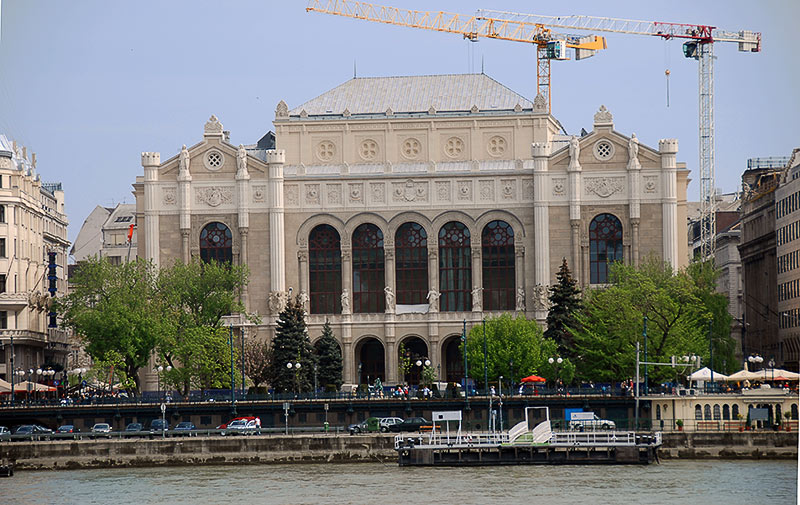
Ybl’s most important contemporary was Friges Feszl (11884) who was also an historicist architect.  Feszl’s  work, however, was less historically “pure,” and contained hints of the future.  Feszl was trained in Germany and used the German rundbogondstil (Romanesque rounded arches that also vaguely suggested the "east"--the purported origin of Hungarian people). Feszl also collected  drawings of what he called "Hungarian motifs."  Feszl's most famous building, the Vigado (or Assembly Rooms, now a concert hall) features a facade that gestures towards Byzantine or vaguely "Moorish"  style.  And on the north side of the building are enlarged copies of “vitezkotes, the ornamental cord of traditional Hungarian costume (Sisa, "Hungarian," 175).  (Get picture).  In his evocation of  Eastern styles and Hungarian folk motifs, Feszl is considered by some as a precursor to Odon Lechner (see Chapter 2.)

Fig. 1.5.  Figure 1‑5.  Vigado (1860-1865), Frigyes Feszl.


The question of the search for a national style came to the fore in 1860-1862, during the competition for the Hungarian Academy of Sciences when it developed into a “national polemic” (Sisa, Lechner, 13).  The major theorist in this debate was Imre Henszlmann (1813-1888), an architect and one of the first historians of architecture in Hungary.  (Feszl did not present a theoretical argument for his choices in the Vigado).  Henszlmann specifically advocated neo-Gothic as the style for public buildings.  This was a hotly debated issue because, on the one hand, many felt that Gothic was appropriate only for religious buildings, and, on the other, many argued that the potential for a unique Hungarian style existed and should be developed.   In response to this competition, Henszlmann gave lectures and wrote papers in defense of neo-Gothic.  His rationale was that Gothic flourished in the Middle Ages, which was Hungary’s golden period, and that he did not believe Hungary had a national style.  Others responded, arguing that a national style did exist, whose origins were “oriental” and best reflected in the Byzantine (Rundbogenstil) manner.  In the end, neither side won, as Count Emil Desweffy, the chair of the committee , preferred Venetian Renaissance and awarded the competition to the Prussian architect Frederich August  Stuler (1800-1865).  (For a fuller discussion of the tension between historicism and national style, see Sis, "Hungarian.)GET PIC

The tension in historical styles is evident even in the premiere national building of the nineteenth century: the Hungarian Parliament.  The contest to design Hungary’s Parliament was issued in 1882.  The commission was awarded to the  historicist advocate and architect Imre Steindl.  Steindl offered the following rationale for his choice, repeating Henszelmann’s argument that the Gothic corresponded with Hungary’s golden medieval past:  “While designing the Parliament, I made no attempt to create a new style; such a monumental structure, built to survive centuries, cannot display ephemeral details.  I rather strove to implant national and individual spirit into the majestic style of the Middle Ages, as art always requires, in a modest and careful manner” (qtd. in Moravansky, p. 68).  There was much dissent.  However, the planning committee for the new Parliament endorsed Steindl’s rationale:  “Gothic is not a national style; but since we have no national style, [the committee] agrees to select this style of not German but French origin, to represent the most majestic ideals of freedom and power” (emphasis mine; qtd. in Moravansky p. 68).  


Figure 1‑6.  Hungarian Parliament (1885-1904).  Imre Steindl.

But while the Hungarian Parliament does borrow from French Gothic, it is not stylistically pure.  The Gothic elements, for example, suggest the quasi-religious character of the promise of parliamentary democracy but are at odds with the building’s baroque size and arrangement of the interior spaces (particularly the dome).  Akos Moravanszky argues that “the difficulties of adopting Gothic structural elements and details to the baroque principles of spatial and mass composition arise from the symbolic program” and cannot “be explained as an adaptation of a historic model to solve a new building task.”  Rather (like the new Viennese Parliament), the Budapest Parliament “appear[s] as didactic assemblages, presenting history as seen from a rearview mirror that condenses the view into a compact scope.”  In particular, the “Gothic of the Budapest Parliament was a clear rejection of Ringstrassenstil and a reaffirmation of the reformist goals of Gothic revival with all its  associations of joyful labor, craftsmanship, and national virtures.  But finally it was the baroque principle of theatrical special arrangement of fragments as parts of a new spatial identity that dominated. . . . “ (69-70). The signature building of Hungarian Historicism thus signals not only the historicist program, but also points to its constraints as Hungarian national goals developed in the twentieth century.  Hungary, however,  did not immediately reject historicism.  Instead it combined historical styles to create new aesthetics and functional possibilities. 
Next up:  Eclectic Historicism.  


Thursday, November 12, 2015

We Are Going Back to Budapest in the Spring!


Here is the long and the short of it:

We have been fruitless (so far) searching for a condo to buy, probably because our requirements are so specific.  We will start renovations on our house, to get it ready for the market in January. We are hopeful that the season will pick up post-holidays and that we will find something.

We had thought that we would have to just stay in Louisville til we bought condo and sold house.  So we had reluctantly put aside plans to go to Budapest in February.  But then Tony thought March!  House repairs should be done then.  Which means that if we buy something in January or February, we could leave with our house up for sale.  If we haven't bought something by March, then we will just take the risk of missing the a possible purchase.  The truth is, we aren't under the gun to move, and the worst that could happen is that we go into another summer.  But if we do, this time the house is ready to go on the market directly after the condo sale.  Probably not the most efficient plan, but it makes us happy.

We immediately contacted our wonderful friend and landlord, John Farago.  He told us what was available, quoted us a reasonable price, and put us on the schedule.  He will let us have the best apartment available; it probably won't be the same place we sayed last year, Apartment Andrei, but wherever it is, it will be wonderful, As soon as we made the decision and John confirmed availability in our price range, I immediately became happy in the way that only an anticipated trip can make one,  I looked up what operas will be playing in March (Manon, Die Walkure, Faust, Banc Ban), what concerts, etc.

Our long-range plan is to try to go to Europe once each spring.  Ideally, we would like to stay a month in Budapest (we just love the city and feel so at home there), then do a week or so somewhere else, e.g. Vienna, Munich, small Italian cities, etc.  Whether we do the add-on or not this year is yet to be determined.

One other small item.  I have decided to write a book on Hungarian architecture and self-publish it on Amazon.  I realized I really needed another writing project in retirement, and I had no desire to go back to the kind of scholarship I did as an academic.  I have just about drafted the first chapter (part of which I will post on the blog soon, hoping to get some feedback).  So I really NEED to go back to Budapest to take more pictures.  (Insert smily face here.)

 #Budapest #RetirementProject

Saturday, May 9, 2015

Anonymous: Miklos Ligeti


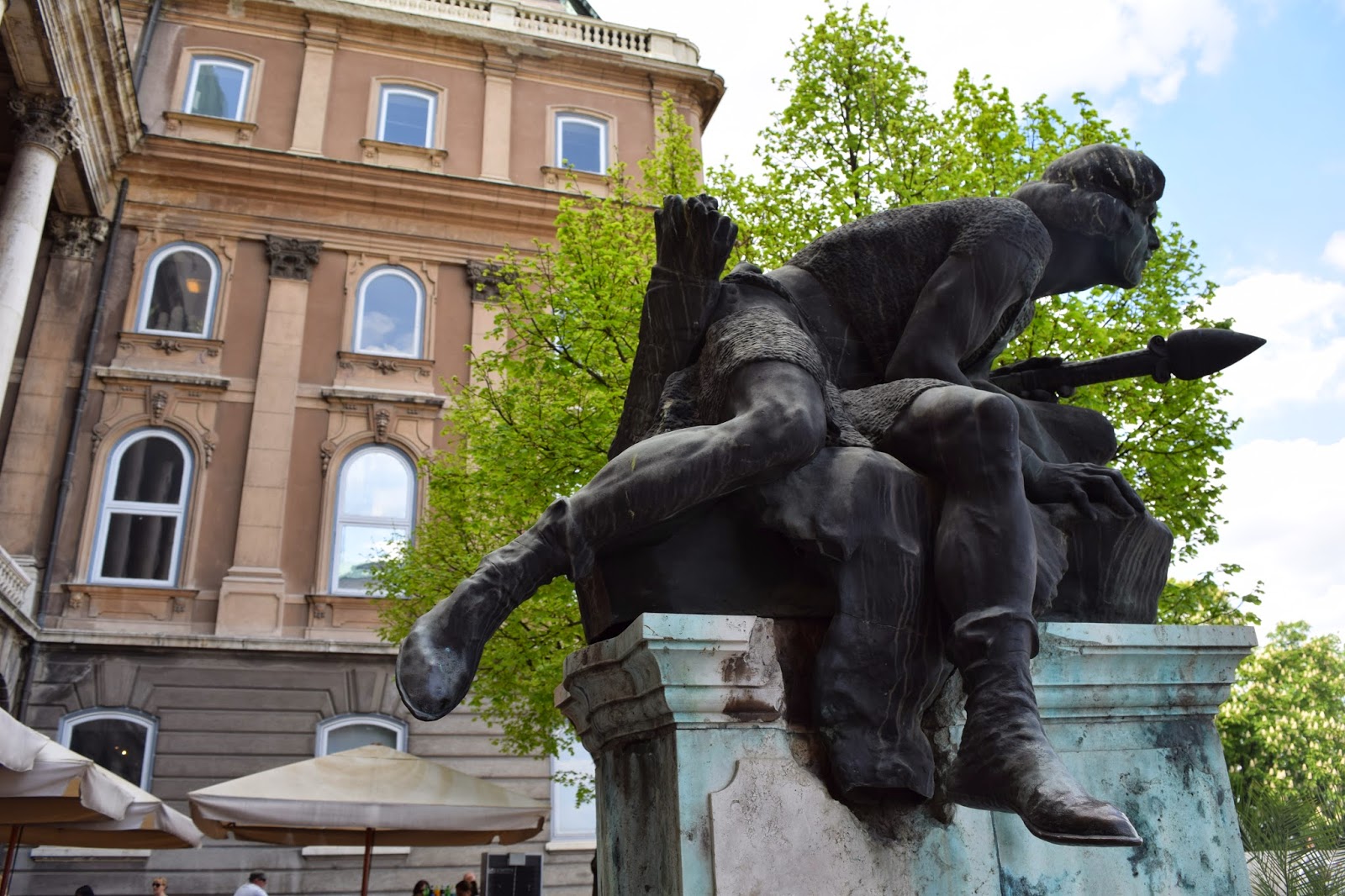
One of the most famous sculptures in Budapest is the statue of "Anonymous" (1903), by Miklos Ligeti (1871-1944), outside the Castle in Varosligeti Park.  The sculpture depicts the the anonymous writer of Gesta Hungaricum, a detailed history of the arrival of the Hungarians into the Carpathian Basin, that was written around 1200 by an unnamed scribe. It is thus a key founding document in the Hungarians' sense of themselves as a nation and a people.

Apparently, those commissioning the sculpture wanted Ligeti to use a typical "Hungarian" face. But Ligeti, instead, kept the statue anonymous, hiding the writer's identity, and emphasizing, instead his almost organic connection to the book he was writing.


But in some ways Ligeti himself is also "anonymous," at least to non-Hungarians.  There is virtually nothing in English about him, published or on the internet, save a very brief Wikipedia entry.  There is similarly little about him in Hungarian.  Everyone knows the statue Anonymous; when we visited, we had to stand in line to take a picture, following people who posed with the statue.  But I think few people would know the name of the sculptor.  There is a small book about him, commissioned by his family that is mostly his biography, I think; I located one copy in Budapest and bought it, even though it's in Hungarian and I won't be able to read it. (It does have pictures.)  He is another example of the many extraordinary Hungarian artists who are simply unknown outside of Hungary.

Ligeti is notable, in my view, for his focus on the human body, especially as is it poised in action. Two of his most famous sculptures in Hungary are the statues of Tunde and Csonger, characters in a famous 19th Century play by Vorosmarty.


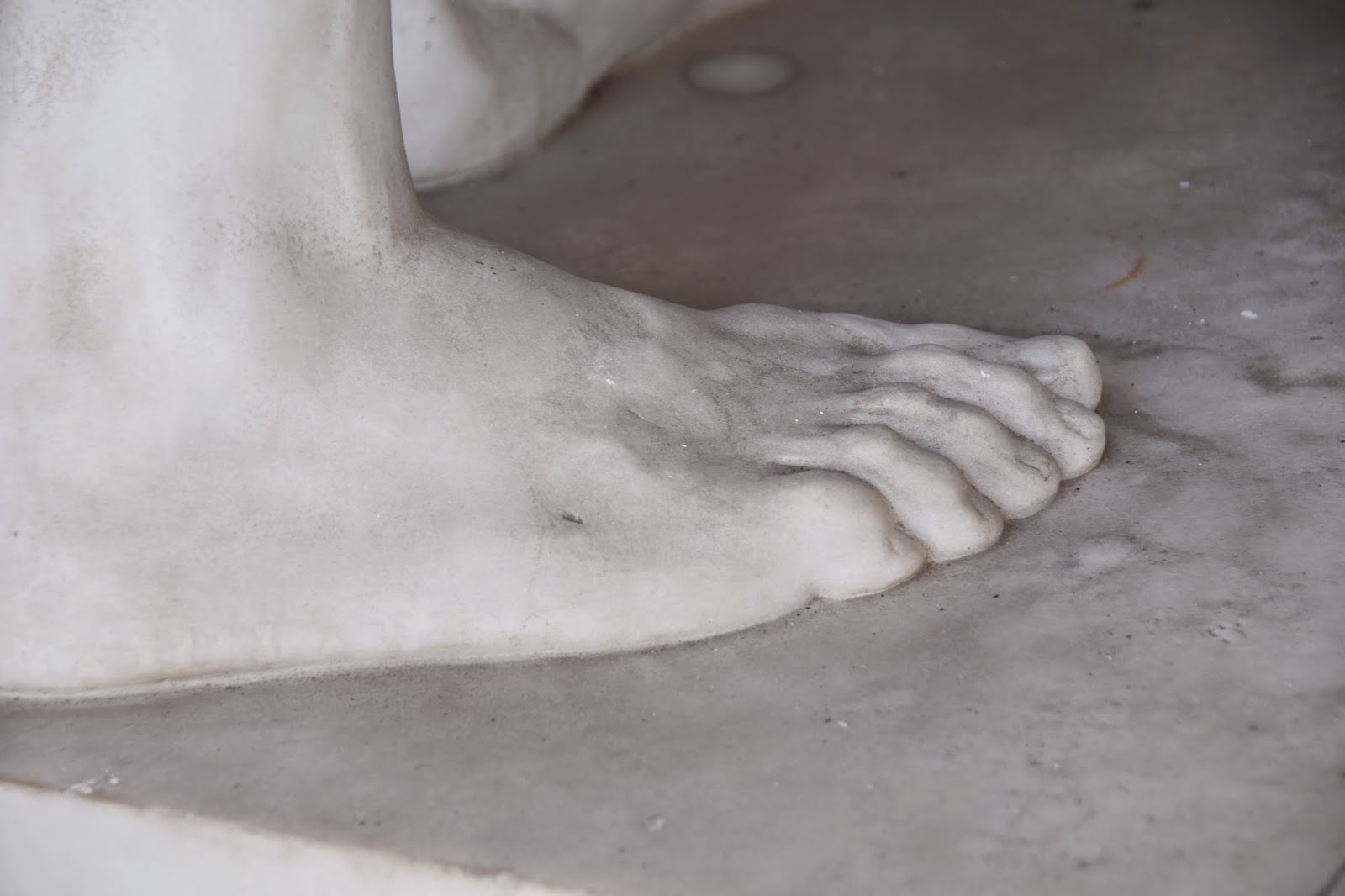
(There is often something very interesting about the feet.) 


Ligeti studied for a time with Rodin, and you can see that influence in statues displayed in the Hungarian State Art Museum.


There is a kind of natural human lyricism to Ligeti's work--a love of the body.  Below are statues he sculpted for the Adria Palace--then an insurance building, now The Meridien Hotel.  They illustrate different kinds of insurance.


Notice how the foot is grasping the pedestal for balance.


The same human naturalism is present in his funerary statuary.


Ligeti was also famous for his portrait sculptures.  Here Crown Prince Rudolph (who either committed suicide or was murdered at Mayerling):


And here Major General Harry Hill Bandholtz in Szabadsag (Liberty) Square in front of the US Embassy.  Bandholtz was the US representative to the Inter-Allied Supreme Command's military mission charged with disarming Hungary.


Most of the artists I discovered in Hungary were completely unknown to me until I began to plan this trip to Budapest.  I knew some of the architects from earlier trips, and I had located important novels from lists of best Hungarian fiction.  But so many others were, like Ligeti, anonymous--at least to me.

Hungary is one of the most culturally rich countries I have been privileged to visit.  A country the size of New Jersey, it has produced 13 Nobel Laureates.  It has a robust history of pictorial and plastic arts.  Its architecture is astonishing.  Its literary history has produced great writers, many of whom remain untranslated and thus unknown outside of Hungary itself.

Part of the reason Hungarian culture is anonymous for non-Hungarians is that Hungary's most significant cultural border is its "orphan" language.  Arising from the Urals in Siberia, Hungarian is unrelated to Latin or Germanic languages; it thus offers non-Hungarians nothing to hold onto. This linguistic isolation meant that Hungary's verbal art at least was simply unknown outside the country.  I think the  Hungarian language, shared only by those who consider themselves Hungarian, is both a powerful resource for producing a sense of nationality and culture, and a barrier that keeps non-Hungarians outside.  If I had another lifetime, I would learn Hungarian.  As much as possible, I would like to see Hungary from the inside, to learn the name and history of those "anonymous" artists.

#MiklosLigeti  #Budapest  #Hungary