Showing posts with label Ligeti Miklos. Show all posts

Monday, April 11, 2016

Homes: Miklos Ligeti--Where He Lived and Where He Died

Miklos Ligeti Home and Studio. Stefania ut 20.
I have returned from Budapet with homes much on my mind.  We are getting ready to sell our house of 27 years and move into a small condominium. While I was in Budapest, I also thought a lot about homes.  I have always been interested not only in the architectural history of the houses I admired, but was also in those who lived there.  This year, I found a new guidebook that offered some of that information.  Reading the abbreviated histories of several houses and their occupants made me want to find more.  And as I have been writing my own book about Hungarian architecture, I have tried, to the extent possible, to locate the names of original owners.  I also became interested in finding the houses of people whose lives, for one reason or another, interested me.  (This was the incentive to find one of the Neuschloss homes at Apostol utca 13b--surprisingly, my most popular post.)

I have documented in this blog my growing interest in the sculptor Miklos Ligeti--an interest spawned by several pieces of his  remarkable sculpture  as well as my meager knowledge of his life story.  (Oh to be able to read Hungarian!)  Returning to Budapest this year, I decided to track down his home--where he lived in Budapest.

This was not particularly easy, as there is little on the web about Ligeti,  But I eventually discovered that his house had been designed by the noted architects Zoltan Balint and Lajos Jambor. Following their history, I learned they had built a house and studio for Ligeti between 1899 and 1900 on Stefania ut 20,  The house is in a neighborhood where many other artists lived, east of the large park Varosliget and very near Odon Lechner's Geological Institute.  The picture above is a photograph of the villa taken sometime before World War II.

Ligeti's house is relatively modest: only two stories with an attached studio. He left it sometime during 1944 to enter the Budapest ghetto.  There is some talk of making it into a museum (put the website into google.translate.com to get a rough English translation), but it has deteriorated so much that may not be practical.  Currently, the house is behind a locked gate, and it appears to be occupied by squatters.  Here are some of the (depressing) pictures taken by pushing my camera through a whole in the fence.


The home is where the body lives: shelter, warmth, sustenance.  Ligeti's home was built to fit the particuar needs of a sculptor.  Wrenched from his home, Ligeti (like other victims of the Holocaust) must have felt deprived of the protection a home offers.  Ligeti's decaying house is the obverse of one of his most famous funereal monuments, the sculpure of a naked man, guided by an angel, entering the tomb, his final "home."


Ligeti himself had no tomb or final "home."  He disappeared in Budapest during the end of World War II.  His monument makes us aware of his absence: he has left his clothes, his hat, and his stick, but he is simply gone. 
#MiklosLigeti
#Homes
#Budapest
#DisappearingPast

Monday, December 21, 2015

Was Miklos Ligeti Jewish?


Last spring, I wrote a post on Miklos Ligeti's sculpture.  I first became acquainted with Ligeti's sculpture in the Kerepesi Cemetery in Budapest.  The Kerepesi Cemetery was the main Christian cemetery in Budapest at the end of the nineteenth and beginning of the twentieth centuries.  Behind the Kerepesi Cemetery is the Jewish Salgotarjani Cemetery, much less kept up, much more difficult to enter and view,  The tombs by Ligeti in the Kerepesi Cemetery feature the nude human body and physical manifestations of angels--both quite distinct from the Jewish tradition of funeral art:


Ligeti also sculpted important politicians, artists, and even the royal Austro-Hungarian family.  But his most famous statue is Anonymous, which for many captures the essential Hungarian identity.


It was thus a complete surprise for me to read in Jewish Budapest: Monuments, Rites, History (by Kinga Frojimovics, Geza Komoroczy, Victoria Pustai and Andrea Strbik) the following passage:

"The Regent [Miklos Horty] issued privileges at special requests for some people who now fell under the (Anti-) Jewish Laws but who had outsanding scholarly, artistic, economic achievements to their credit or who filled prominent public roles.  . . .  Among them were several prominent. . . writers and artists, [including] . . Miklos LIgeti, the sculptor of the statue (1903) of the first Hungarian chronicler, Anonymous, located in Varosligeti (City Park)" (p. 402).

That Ligeti could be Jewish seemed almost impossible.

So I did some research.  Miklos Ligeti, sculptor is listed in the Maygar Zsido Lexicon (Hungarian Jewish Encylopedia), published in 1929 in Hungarian.  Ligeti is also listed on ArtCult: Around Jewish Art,

The answer to how Ligeti could be Jewish but seem (in his art) so un-Jewish is of course the widespread cultural assimilation of Hungarian Jews in the last part of the 19C and first part of the 20C.  The historian and political writer Ferenc Festo, who includes Ligeti in his discussion, explains this more thoroughly.

Ligeti died in 1944 (the death year for so many Budapest Jews). As Jewish Budapest goes on to explain, the special "accommodation" for outstanding Jewish citizens declined after the Arrow Sword terrors. ArtCult says that Ligeti "disappeared" in Budapest in 1944.  His wikipedia page and other websites place his death on December 10, 1944, the day the Budapest Ghetto was sealed.  Interestingly, in a book published by the museum his family runs, Ligeti Miklos by Prohaszka Laszlo, Ligeti's death is also placed on December 10, 1944--though there is no mention (as far as I can tell using Google translate) of his residing in the Ghetto or dying because of the Holocaust.

Ligeti's own funeral monument is located in Kerepesi Cemetery, though his body (which was lost) is not.  The monument sculpted by his friend Jeno Bory poignantly depicts the missing presence.

  .
In the abstract to her doctoral thesis, Treat ment of Miklós Ligeti ,sculptor’s ouvre, Judit Mazányi writes that "Surveying his oeuvre, it became indisputable that we were not kept waiting for the rediscovery of the life-work of a forgotten genius sunken into oblivion":

"Sadly, no drawn sketches have survived from the artist, nor sculpture studies of a notable number, through which the evolution of his ideas could have been traced. Many hundreds of his drawings fell victim to the mistaken judgment of his family members, who, in the cultural-political situation following the war might have thought that there would not be any chance to present his oeuvre as integrated into Hungarian art. I do not know which of his works were placed in a private safe during World War II as planned by the artist, but it is common knowledge that the valuables preserved in these were hardly spared in the course of wartime plunder, and these works have most probably been destroyed."

The hooded face, the body-less monument, the Jewish identification, the non-Jewish artist: it is tempting to draw these together.  But the truth of Ligeti's life is surely more complex than these teasing traces suggest.  It is also as incompletely known as those of so many Hungarian artists who are no longer familiar to us or to their fellow citizens--either because of history, neglect, or accident.

 Whomever Ligeti was is now gone.

#MiklosLigeti
#JewishBudapest

Saturday, May 9, 2015

Anonymous: Miklos Ligeti


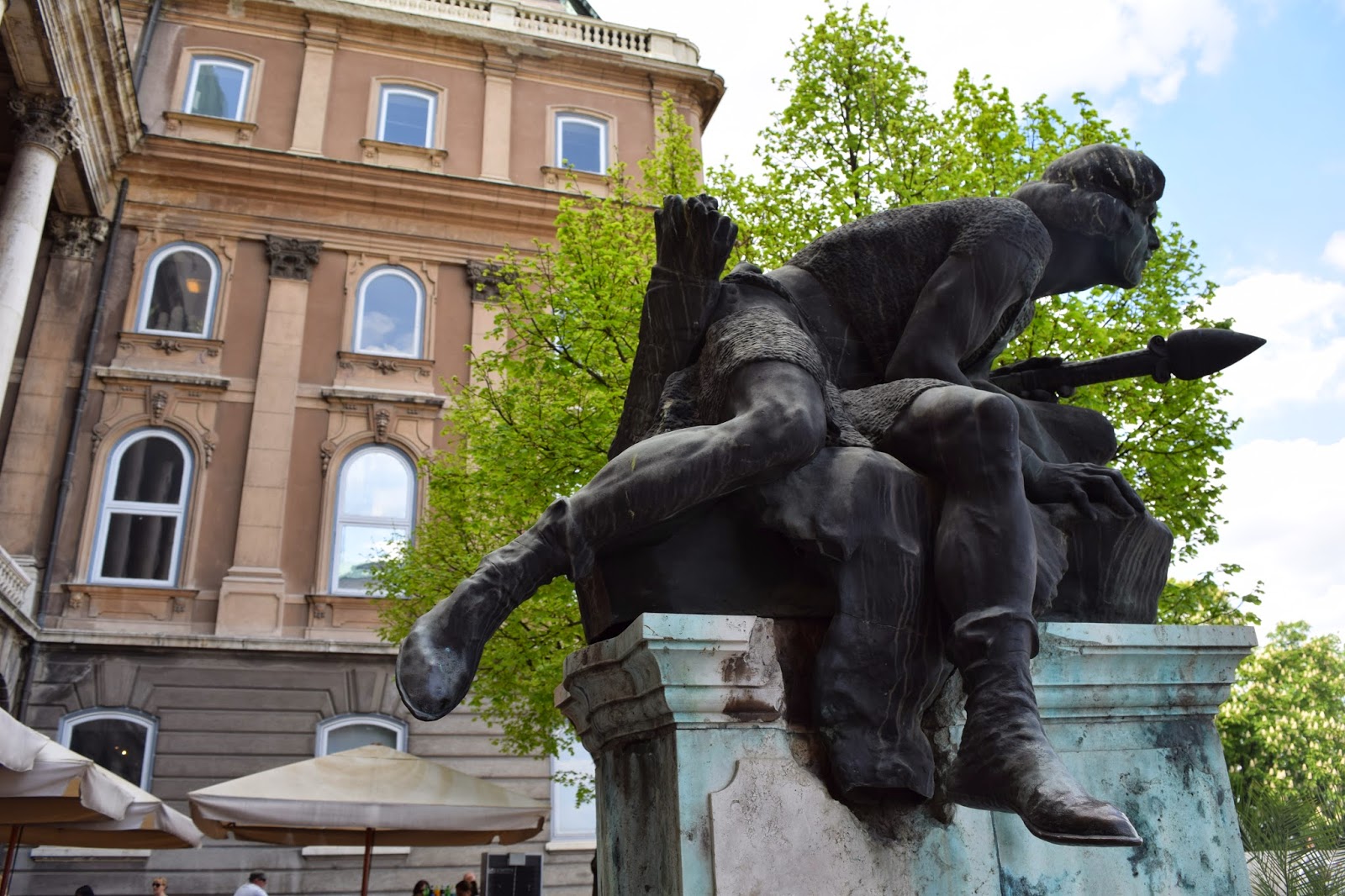
One of the most famous sculptures in Budapest is the statue of "Anonymous" (1903), by Miklos Ligeti (1871-1944), outside the Castle in Varosligeti Park.  The sculpture depicts the the anonymous writer of Gesta Hungaricum, a detailed history of the arrival of the Hungarians into the Carpathian Basin, that was written around 1200 by an unnamed scribe. It is thus a key founding document in the Hungarians' sense of themselves as a nation and a people.

Apparently, those commissioning the sculpture wanted Ligeti to use a typical "Hungarian" face. But Ligeti, instead, kept the statue anonymous, hiding the writer's identity, and emphasizing, instead his almost organic connection to the book he was writing.


But in some ways Ligeti himself is also "anonymous," at least to non-Hungarians.  There is virtually nothing in English about him, published or on the internet, save a very brief Wikipedia entry.  There is similarly little about him in Hungarian.  Everyone knows the statue Anonymous; when we visited, we had to stand in line to take a picture, following people who posed with the statue.  But I think few people would know the name of the sculptor.  There is a small book about him, commissioned by his family that is mostly his biography, I think; I located one copy in Budapest and bought it, even though it's in Hungarian and I won't be able to read it. (It does have pictures.)  He is another example of the many extraordinary Hungarian artists who are simply unknown outside of Hungary.

Ligeti is notable, in my view, for his focus on the human body, especially as is it poised in action. Two of his most famous sculptures in Hungary are the statues of Tunde and Csonger, characters in a famous 19th Century play by Vorosmarty.


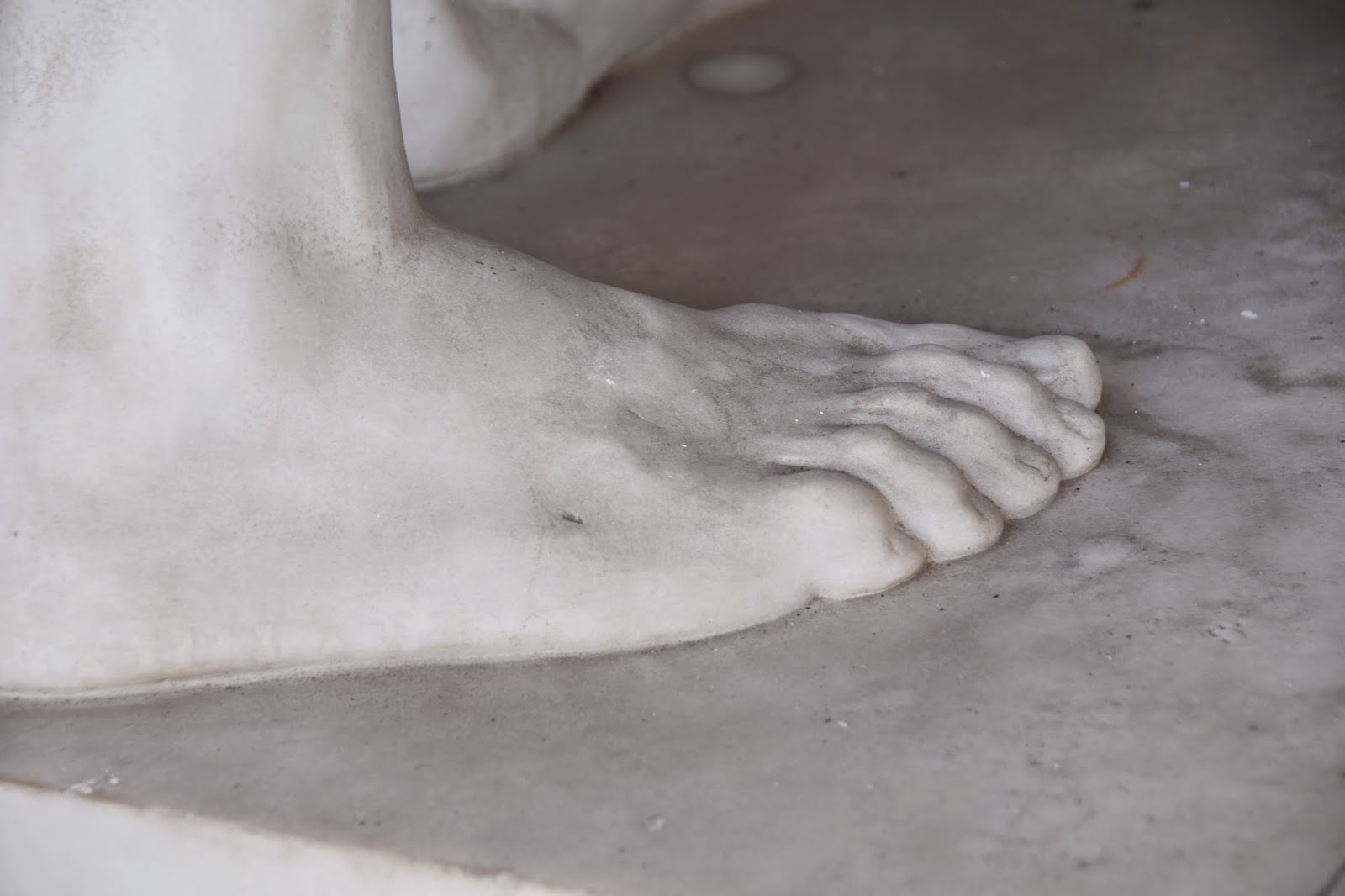
(There is often something very interesting about the feet.) 


Ligeti studied for a time with Rodin, and you can see that influence in statues displayed in the Hungarian State Art Museum.


There is a kind of natural human lyricism to Ligeti's work--a love of the body.  Below are statues he sculpted for the Adria Palace--then an insurance building, now The Meridien Hotel.  They illustrate different kinds of insurance.


Notice how the foot is grasping the pedestal for balance.


The same human naturalism is present in his funerary statuary.


Ligeti was also famous for his portrait sculptures.  Here Crown Prince Rudolph (who either committed suicide or was murdered at Mayerling):


And here Major General Harry Hill Bandholtz in Szabadsag (Liberty) Square in front of the US Embassy.  Bandholtz was the US representative to the Inter-Allied Supreme Command's military mission charged with disarming Hungary.


Most of the artists I discovered in Hungary were completely unknown to me until I began to plan this trip to Budapest.  I knew some of the architects from earlier trips, and I had located important novels from lists of best Hungarian fiction.  But so many others were, like Ligeti, anonymous--at least to me.

Hungary is one of the most culturally rich countries I have been privileged to visit.  A country the size of New Jersey, it has produced 13 Nobel Laureates.  It has a robust history of pictorial and plastic arts.  Its architecture is astonishing.  Its literary history has produced great writers, many of whom remain untranslated and thus unknown outside of Hungary itself.

Part of the reason Hungarian culture is anonymous for non-Hungarians is that Hungary's most significant cultural border is its "orphan" language.  Arising from the Urals in Siberia, Hungarian is unrelated to Latin or Germanic languages; it thus offers non-Hungarians nothing to hold onto. This linguistic isolation meant that Hungary's verbal art at least was simply unknown outside the country.  I think the  Hungarian language, shared only by those who consider themselves Hungarian, is both a powerful resource for producing a sense of nationality and culture, and a barrier that keeps non-Hungarians outside.  If I had another lifetime, I would learn Hungarian.  As much as possible, I would like to see Hungary from the inside, to learn the name and history of those "anonymous" artists.

#MiklosLigeti  #Budapest  #Hungary