Showing posts with label Secession. Show all posts

Wednesday, March 4, 2020

Rath Gyorgy Museum: Art Nouveau--a Hungarian Perspective


It was rainy yesterday, so we went to the list of museums we were saving for an indoor day, choosing the Rath Gyorgy Villa, Rath Gyorgy (1828-1905)--or Gyorgy Rath as we would say in the US--was an esteemed jurist and legal scholar.  In addition, he was an important collector of art, including major European paintings (now in the Museum of Fine Arts) and works of Art Nouveau, including those of Austria and England, but most significantly Hungarian Secession.  He organized the Museum of Applied Arts in 1881 and was its first director until 1896.

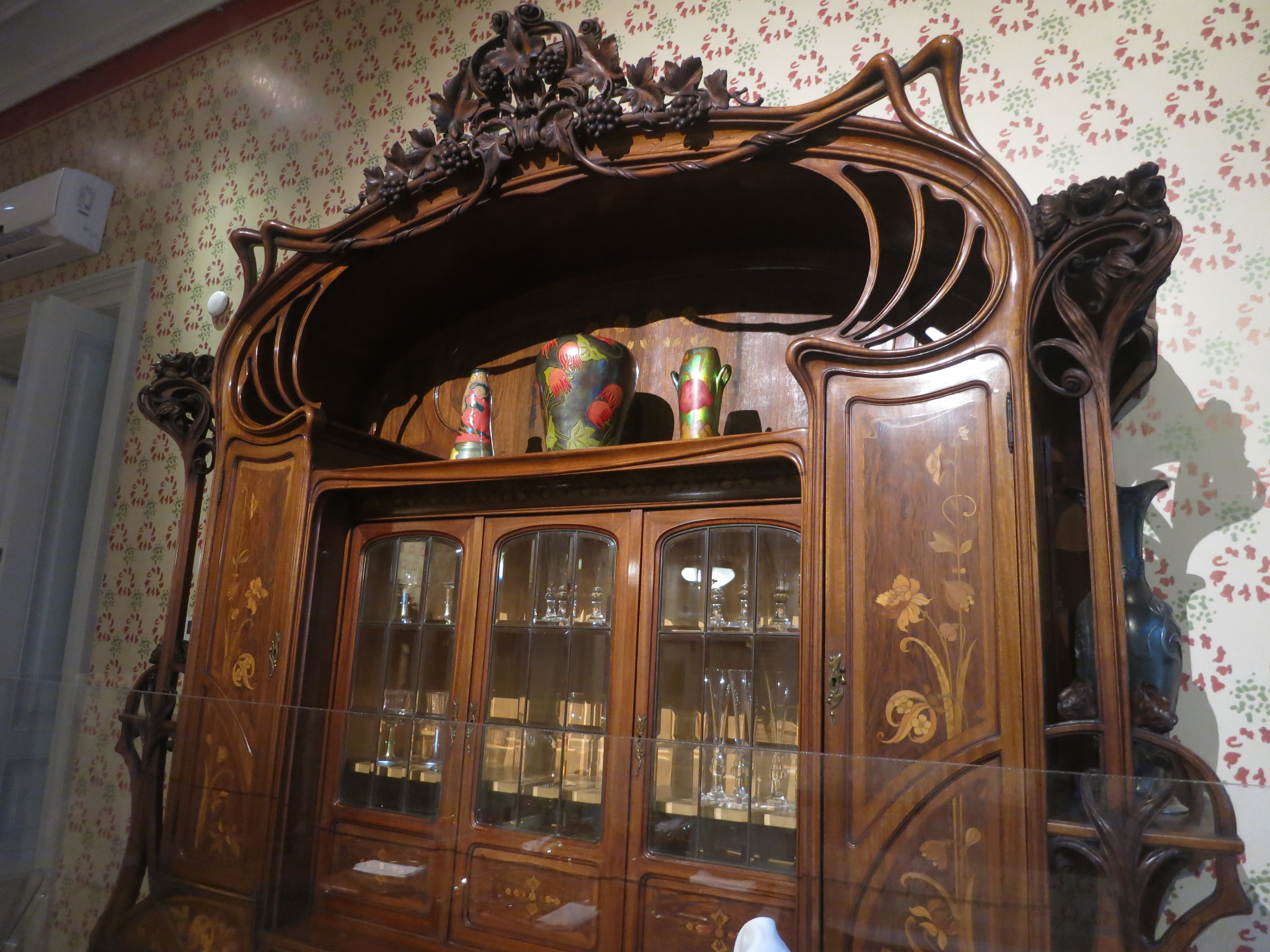
When he died, he left his art collection to his wife who, in turn, left it to the Museum of Applied Arts with the stipulation that it would form "the National Rath Gyorgy Museum constituting an auxiliary part of the Museum of Applied Arts, which is inalienable and must be contained together."  The museum was established in his villa at Varosligeti fasor 12, opened in 1906 and visited by Emperor (King in Hungary) Franz Jozsef in 1908.  In 1948, the collection was broken up for ideological reasons, the proletarian dictatorship considering it dangerous to celebrate a bourgeois apartment.  The museum re-opened in 2018.  It includes much of Rath's original collection (most specially Zsolnay pieces and tiles), many collected in a series of cases,  and a series of rooms designed to show what Hungarian Secession furniture and ornaments look like as used.

The highlight for me was the Dining Room.  In this room, no piece (furniture, art, table settings) has a straight line; every piece includes the Art Nouveau curve.


 There is also an Art Nouveau sitting room


And there is the house itself,  stairs and wooden settings by Pal Horti, iron gates by Gyula Jungfer,.


 A beautifully organized and maintained museum: recommended for anyone interested in Art Nouveau or Secession.

From the Museum


#Rath Gyorgy Museum


Sunday, March 5, 2017

Prague. From Baroque to Secession in the Blink of an Eye


Yesterday, we walked from our hotel on top of the hill near the castle, down through the Little Town, Mala Strana (basically Baroque), over the Charles Bridge, though the Old Town (Stare Mesto) to the edge of the New Town (Nove Mesto).  In the morning, we passed by one of the largest churches in Prague, the monumental St Nicholas Church, that sits very near the Charles Bridge.  It is a huge and incredibly imposing church.  It is just about the most over-the-top High Baroque Church I have ever seen.  Pictures don't really show its magnitude.  It is overwhelmingly large and highly ornate.


It was built for the Jesuits by the Dietzenhofer family, father and son, between 1703 and 1761.  The upper cupola is so high, the congregants were afraid it would fall on them.  The church borrows Baroque principles from Borromini and Bernini but extends them into ever more complicated spatial programs.  Every square inch seems to be decorated.

After seeing the church we crossed the Charles Bridge, walked through the Old Town (Stare Mesto), one Baroque house after another, interspersed with the occasional Renaissance and Gothic.  (No Historicism here; this is pure Historic.)  We found ourselves near the National Theater on the embankment.  And all of a sudden, we realized we were at the beginning of a row of the most amazing Art Nouveau, Secessionist houses.  We had read that there was Secession in Prague, but all the guide books mentioned the same buildings   I had no idea there would be so much, and that it would be so concentrated.  Apparently there was a move to "clean up" Prague at the turn of the century in the urban renewal that many European cities went through around that time.  In Prague, over 600 buildings were razed.  (This was, as you might expect, a controversial action, because what got torn down was more historic architecture.)  So we kept coming on areas where Secession buildings were clustered.  But the ones on the Masyrak Embankment were something special, all lined up one after another.


There they were: one amazing building after another.


And filled with the most beautiful and unexpected details.


I probably could--if I spent several years of intense study--learn to "read" the Baroque St. Nicholas, but for whatever reason, it doesn't call me.  I first saw Art Nouveau or Secession architecture when I was in Timisoara Romania.  Before I saw it there, I really didn't know it existed.  And so for me, there has always been this powerful sense of discovery, which is intensified by the fact that, except for the most famous buildings, one tends to stumble onto Art Nouveau architecture.  It surprised me that there was so much in such an old city like Prague.  But I kept seeing it, and everytime I did, it was like "Hello!"  

Walking around Prague is the most intense "architecture experience" I have ever had.  More so even than beautiful cities like Paris or Rome, because here there is virtually nothing except stone.  No green spaces or wide boulevards.  Just lots of buildings crowded side by side, separated by narrow cobblestone streets, plus of course the bridges (which are also sculpted like buildings).  (And the fact that it's jammed with tourists only adds to the almost claustrophobic sense of abundance.)  I have taken about 2000 pictures since I got here, and I know there are too many.  How does one every make sense of so many pictures?  How does one make sense of a city like this?  It seems a life-long project, but not, alas, for me.

#Prague
#architecture
#Baroque
#ChurchofSaintNicholas
#secession
#Art Nouveau
# MasyrakEmbankment

Monday, January 26, 2015

What Does Research Look Like When You Are Retired?


Dome of Szeged Syngogue.  Lipot Baumhorn architect.


When I tell people I am going to Budapest for three months, some of them look a little puzzled.  I think that is partly because Hungary (especially in the winter) is not the kind of obvious place to do a big retirement trip in the way France, Italy or the UK might be.  But I hope if you follow along with me on this blog, you will get a sense of why Tony and I love it so much.

When I say three months in Budapest, I often get a follow up question: "are you going there for research?"  Well, this is actually a complicated question that is difficult to answer.  No, I am not going there to do research of the sort I did when I was a working academic.  But yes, along with indulging in a whole range of other pleasures, I am going there to follow a research-like trail. If you have been reading my blog, you will know I am fascinated with Hungarian Secessionist architecture.  This fascination is grounded in aesthetic pleasure, but it is not just that.  I want to know about these buildings: their history, context and meaning.  I am hindered in my quest by my inability to understand the Hungarian language (and at this point in my life have to accept that this will always be the case). But I have done as much as I can: reading research written in English on Cental European architecture, hunting around the internet, asking friends who are knowledgable.

The main form of my research, though is looking carefully at buildings, taking pictures, and sorting pictures.  I have taken--literally--thousands of pictures. And in the act of looking, recording, sorting, I have built my understanding of how these buildings "work" inductively, following what perhaps might be called a kind of naive grounded theory.

I have been engaged in research and scholarship all of my adult life.  And that work has always been geared towards some kind peer-reviewed, academic publication.  What does research look like or even mean if it does not result in some kind of product?  And does that product have to be peer- reviewed for me to invest in it?  Would it be satisfying enough to put my (mostly picture) research on the web and hope that interested people will find it? Or do I have to find some kind of "publishing" outlet?

These questions may seem esoteric or even silly to some people.  But they are questions I have been pondering a good deal. Many people, I know, are continuing the research they did before retirement.  At the moment, this doesn't appeal to me.  So is there another kind of research I can engage in, and what would it look like?


Monday, January 19, 2015

Banca de Scont Timisoara 4


Tony and I lived in Timisoara, Romania for five months in 2009, while Tony had a Fulbright at The University of the West.  But I had been to Timisoara earlier.  During my first Fulbright in Sibiu, Romania in 2001, I had gone to the Timisoara BAS Conference. I didn't remember too much about Timisoara from that visit (and it was before I had a digital camera so I didn't have so many pictures).  But one building had stayed in my mind:  the Banca de Scont.


This is a building you have to look at slowly and carefully to see its beauties.  (And which you have to try to un-see what has been added on, especially the jarring business names on the lowest floor.)


Here are some of its beauties.

Its color is a warm, almost adobe, brown


Its ornamentation is turquoise


It has beautiful details like these gutter decorations


And the light fixtures


Tiles adorn the roof


Arranged at various points are small turquoise and white knots, which are modeled from Szekler embroidery


And the front facade is crowned by this beautiful tile piece


I fell in love with this building, and I spent much of my first extended Timisoara stay trying to understand its mysterious appeal.  I learned that 

  • The Banca de Scont was built by Marcell Komor (1868-1944) and Dezso Jakab (1864-1932), two Budapest architects who had earlier worked with Odon Lechner.  I tried to find out more about them on-line, but there was not a lot of infomation.  I did learn that  Komor died in the Holocust.  Eventually I was able to learn more about their lives and their work.
  • I also found out that they had designed other important buildings in Romania, including the Palace of Culture in Targu Mures and the Black Eagle in Oradea.  (Much more on that to come in later blog posts :)  Later I learned about their work in Subotica, Serbia (yes another blog post come on that!) And they have buildings in Budapest and Bratislava.
  • I eventually found out that Banca de Scont meant Discount Bank (and felt really stupid not to have realized that earlier.)
  • I discovered the meaning of some of the ornamentation.  The embroidery knots, for example, suggest a kind of authentic, almost ethnographic, Hungarian identity.  And the hive means it's a bank.  (Also more on that to come.)

I have subsequently gone on a quest to see as many of Komor and Jakab's buildings as I can.  For some reason, I feel an almost visceral connection to them.  I think part of my fascination with them are the historical ironies that surround their lives.  Many of their buildings celebrate Hungarian values and ethnicity; the Palace of Culture in Targu Mures is a particularly strong example. Yet Komor was murdered because he was Jewish, and thus not Hungarian enough.  But part of their appeal is the strength of their voice.  Unlike some Secessionist architecture that seems rather generic, Komor and Jakab's buildings look like they created them.  Their architecture is lyrical and colorful and generous in its spirit.  It is Timisoara that kindled my interest in Hungarian Secessionist architecture in general, and it is Komor and Jakab that helped me see some of that architecture as the work of real genius.