Showing posts with label Italy. Show all posts

Thursday, January 2, 2020

On the Fresco Trail in Italy: Padua, Arezzo, Florence


We knew we wanted to go to Trieste and Florence but had to think about what other two places we wanted to visit in between.  I had always wanted to see the Piero della Francesca cycle of the Legend of the True Cross in Arezzo, and in some ways the trip was organized around that.  Looking for the 4th city, we decided on Padua because of the Giotto frescoes.  Then in Florence we went to various churches famous for frescoes.  The trip wasn't  initially planned as a fresco trail, but that it is what it eventually evolved into.   (I took pictures, not beause they captured what I was looking at in any particularly good way, but  because photographing helped me see close-up and find a focus for that  seeing; that is, I clearly recognize this is NOT "art photography.)


1.  Padua and the Giotto frescoes at the Scrovegni Chapel.


Our visit to the Scrovegni was so spectacular, so powerful, so all-encompassing, and so incomplete.  Incomplete because one is only allowed in the temperature controlled space for 15 minutes.   (You have to make reservations ahead of time, get there a half hour before your time, sit in a special room where you are stabilized to a certain and humidity or whatever for 15 minutes.)  So you and your 24 co-visitors are trying to see as much as you absolutely can.

Since I knew I wouldn't have much time, I did as much research as I could so I would know where to look. I discovered that Giotto(1267-1337) and Dante (1265-1321)  were almost exact contemporaries, and some people say that in their work we can see the birth of Humanism and the early Italian Renaissance.  Giotto is one of the first Italian painters to create religious figures that have both a body that is located within three-dimensional space and also have an individual face or presence. The frescos in the Scrovegni Chapel depict scenes in the life of the Virgin Mary and Christ and were painted in the early 1300s.

This panel, Weeping Over the Body of Christ, is said to be Giotto "at the height of his artistry.


The frescos of the Scrovegni chapel are among the best preserved of Giotto's work and are remarkable for their vivid colors, especially the deep blue sky of the ceilind background of the scenes.


2.  Arezzo and the Piero della Francesca frescos of the Legend of the True Cross in the Choir of San Francesco..


I first wanted to see The Legend of the True Cross, Piero della Francesca's most famous and complex work, when I read the John Mortimer novel Summer's Lease, in which the characters travel in a single day to Arezzzo, Sansepulcro, Monterchi, Urbino to see Piero's most famous paintings in situ.  This episode is recounted at the beginning of John Pope-Hennessey's small book, drawn from a lecture, entitled The Piero della Francesca Trail.  Pope-Hennessey tells this story to make the point that Piero's paintings, once not well known, are today very famous. Piero della Francesca's dates (c. 1415-1492) are a little over 100 years later than Dante or Giotto, and the  Legend of the True Cross was painted between c. 1448 to c. 1466--so something a little less than 150 years after the Scrovegni frescoes.

Piero della Francesca's art is marked by new possibilities of perspective in painting, and is much more rational and cool in its emotions.  The narrative of the frescos is much more complex--there is a lot going on. So the cycle itself allows a more varied presentation.  When we were there, it was quite crowded.  (The space is smaller than the Scrovegni, and there were (or at least it felt like there were) more people inside.  You had to jostle for position.  Again, it's hard to know how to look at this kind of art: varied, unfamiliar, not particularly well-lit, lots of people, and a limited time to do the looking.  So my memory (and my pictures) are kind of choppy.


When we left the chapel with the Piero frescoes we wandered through the church and realized it must have been covered in frescoes at one time.


How different it must have felt to decide to paint a picture and hang it on wall rather than paint the whole wall itself.

3.  Florence and the Masolino and Masacio frescoes at the Brancacci Chapel.


The frescoes in the Brancacci Chapel on the other side (altroarno) were painted between around 1423 and 1436 by the two painters Masolino and his younger (and more talented and famous) colleague Masacio.  They tell the stories of St. Peter.  The difference between the two painters can be seen most directly in their separate versions of the story of Adam and Eve, Masolino telling the story of their time in the Garden: elegance.


 And Masaccio depicting their expulsion: psychological terror.
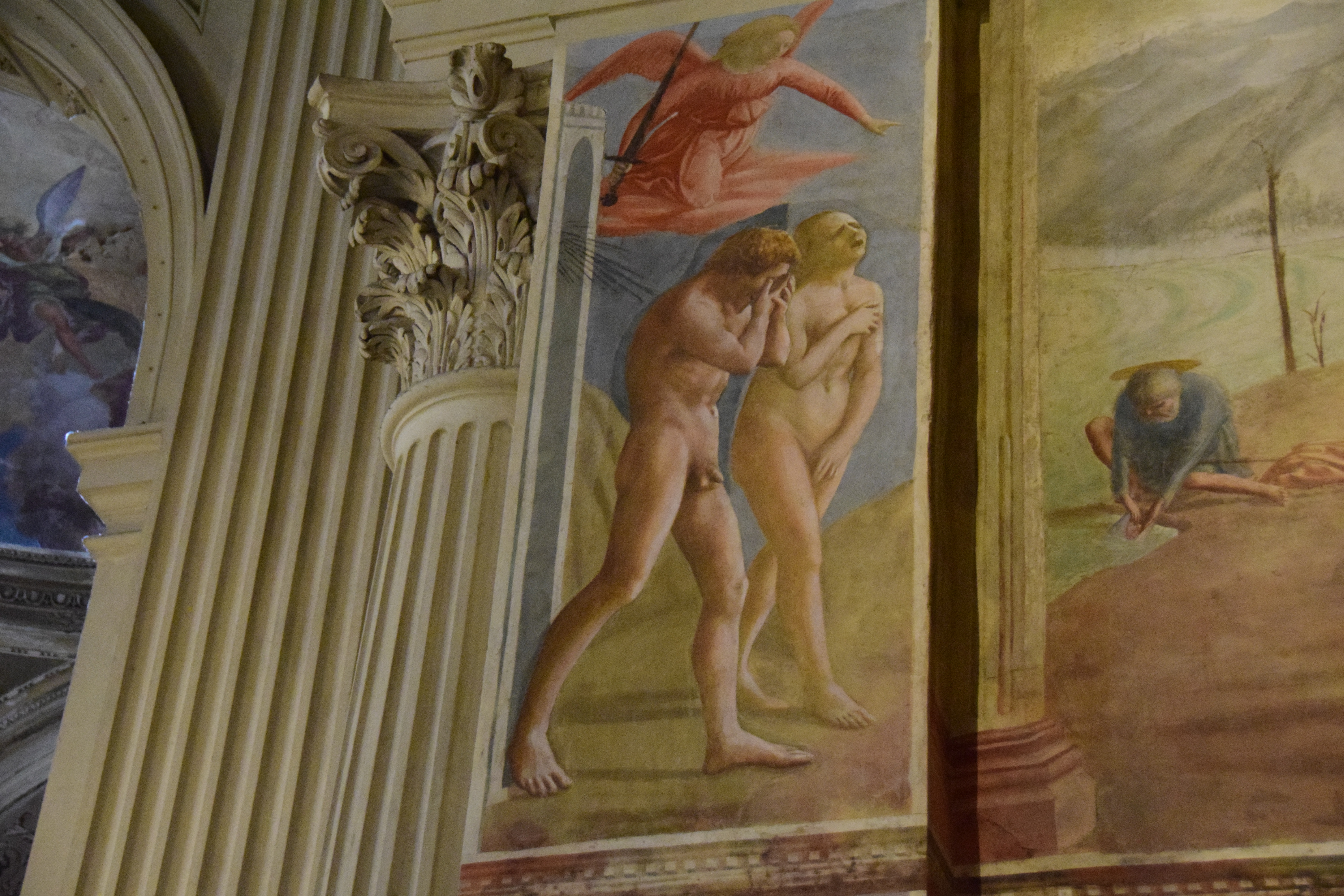


We were also taken with the clever use of architectural space and the unique individualism of the characters.


We remained on the look-out for frescoes and saw more at Santa Croce and Santa Maria Novella.


Actually we saw them almost everywhere!  Or so it seemed.  We were overwhelmed by their beauty, distance, individuality, ambition, state or repair or otherwise. 


Why, you may ask, did I take pictures of these objects, so hard to see and so often reproduced more faithfully by professionals?  I will return to this question in a later blogpost.


#Italy
#Frescoes
#Giotto
#PierodellaFrancesca
#Masaco
#Masolino

Friday, December 6, 2019

Trieste Italy: Where Nowhere is Somewhere


"A great city that has lost its purpose is like a specialist in retirement.  He potters around the house.  He tinkers with this hobby or that.  He reads a little, watches television for half an hour, does a bit of gardening, determines once more that he really will read Midnight's Children, get to know Beethoven's late sonatas or try for a last time to get a grip with rock. But he knows that the real energy of his life, the fascination of his calling that has driven him with so much satisfaction for so many years, is never going to be resumed.  He no longer reads the technical journals, because they make him feel outdated.  He no longer goes to professional conventions.  The world forgetting, by the world forgot!  What's it all been for he wonders?  Jan Morris.  Trieste and the Meaning of Nowhere, p. 167. 


For most of the summer I felt like I might be living in Trieste.  That's the reason I blogged so little.  I puttered around but I didn't really feel anchored.  I read of course.  And I swam and walked as much as I could.  I tried to write, but couldn't get started, so I fiddled around a lot with my pictures. I do feel compelled to say, though, that unlike Morris's specialist, I did not regret the absence of reading technical journals or going to professional conferences.  Otherwise, the desultory retiree's life that Morris uses as an analogue for Trieste felt apt.  I didn't blog because I really didn't feel like I had much to blog about.  I could chronicle my summer, but I couldn't narrate it.

In October Tony and I went to Italy for two weeks.  We flew into Trieste, where we stayed for three days.  Then a train to Padua for three days.  Another train to Arezzo for three days.  Then a train to Florence for five days.  We both got sick, Tony especially so.  It rained a lot.  It wasn't our best trip.  Nevertheless we were in Italy and the notion of a meaningful life filled with adventures (and great food) returned. And hence, I return to the blog.

Tony and I first went to Trieste in 2005, when we were on a complicated route to return from Dubrovnik to Sibiu Romania. After various trains and a ferries we ended up in Trieste, which Tony wanted to visit because he had read Jan Morris's book Trieste and the Meaning of Nowhere.  I knew nothing about Trieste and Tony maybe a little bit more.

Trieste is a strange Italian city, more Habsburg Empire (to which it once belonged) than Italian (where it ended up after World War I.).  At that time I barely knew what the Habsburg Empire was, so I didn't pick up on the kind of strange vibe that, for Morris and to us to some degree, characterizes Trieste.  Almost 15 years later, I learned that Trieste, from its Habsburg Empire days, was known for its Art Nouveau architecture, called, in Italy, Liberty style.  So we decided to go back and see what was what.  It turned out that Trieste is nowhere in the sense that it has shifting history of being pulled around from one country to another, once the great Habsburg port, later an Italian city in a country that already has all the ports it needs: a "colorful "polyglot proletariat" and the wisps of a died out aristocracy.  But it was definitely somewhere in its colorful buildings, expansive piazzas (the one at the top of the post is Piazza Unita, the largest open-to-the-sea piazza in Europe), statues of famous inhabitants ((e.g., Joyce, Svevo, Burton).  It has a feel to it that is unlike any of the other Italian cities we visited on this or other trips.

It also turned out that Trieste doesn't have great Art Nouveau architecture, though it does have a fair amount of it, along with some very exuberant eclectic Historicism.  But somehow the kind of strange over-the-top feeling of some of the buildings adds to the affect.    Here, in no particular order: